Did I just get chatgpt to solve an unsolved math problem?
I want to be careful and precise with what I say because I’m still processing what has happened. I am not a professional mathematician, though, as a Physics PhD, I do enjoy the computational aspect of mathematics. I want to be transparent with my process and my findings, because even if it is a slim chance the result I received from ChatGPT was actually a valid new piece of mathematics, I think it’s worth sharing with the greater mathematical community. And if it’s not a valid result, then, so what? It was an interesting exercise regardless.
Last night, I gave ChatGPT-5.5 Pro the task of solving Exercise 210 on page 96 from Donald Knuth’s The Art of Computer Programming (TAOCP), Volume 4, Pre-Fascicle 8A. The link to the ChatGPT conversation, as well as the Overleaf LaTeX document, and the GitHub repository containing the computer programs that verify the result are found at the bottom of this blog post. Knuth gives each problem a rating value, and states that “All exercises with ratings of 46 or more are open problems for future research, rated according to the number of different attacks that they’ve resisted so far.” Naturally, when I learned of this pre-fasicle’s existence, I searched for these exact type of problems as potential targets for reasoning large language models (LLMs) like GPT-5.5 Pro, the Opus line from Anthropic, and (before it was taken down) the publicly available Fable 5.
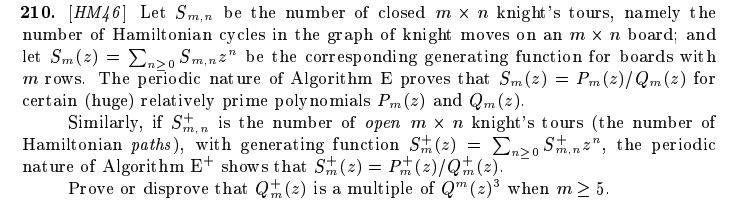
Exercise 2.10 from Donald Knuth’s The Art of Computer Programming
I corresponded with Liam Price a 23-year old from the UK who solved Erdős Problem #1196 using ChatGPT-5.4, a 60-year-old conjecture regarding primitive sets in number theory, who generously offered his template for prompting these reasoning LLMs. While I figured the Erdős problems, which are documented and followed by the wider online math community were probably heavily picked over at this point, (for example, Google DeepMind released a pre-print back in May 2026 solving 9 out of 353 these problems), problems out of Knuth’s TAOCP probably were less studied, given that a lot of unsolved problems are littered throughout his multi-volume book series.
The problem I found from Volume 4 Pre-Fasicle 8A was about closed knight tours in chess. A knight tour is a sequence of moves that allows a knight to visit every square on a chessboard exactly once. A knight tour is defined to be open if the knight ends its tour more than a single move away from its original starting square, and is closed if it lands within one move away. While a chessboard is normally 8 squares by 8 squares, the problem from Knuth focuses on an arbitrary m x n chessboard. I’m not going to pretend that I understand the rest of the problem statement, but I fed it into ChatGPT-5.5 Pro last night using the template Liam Price provided me via X/Twitter. I also followed Liam’s guidance on having the models verify the result, and had Codex and Claude Code with Opus 4.8 independently verify that the source code from GPT-5.5 Pro does indeed produce a valid counterexample to the claim.
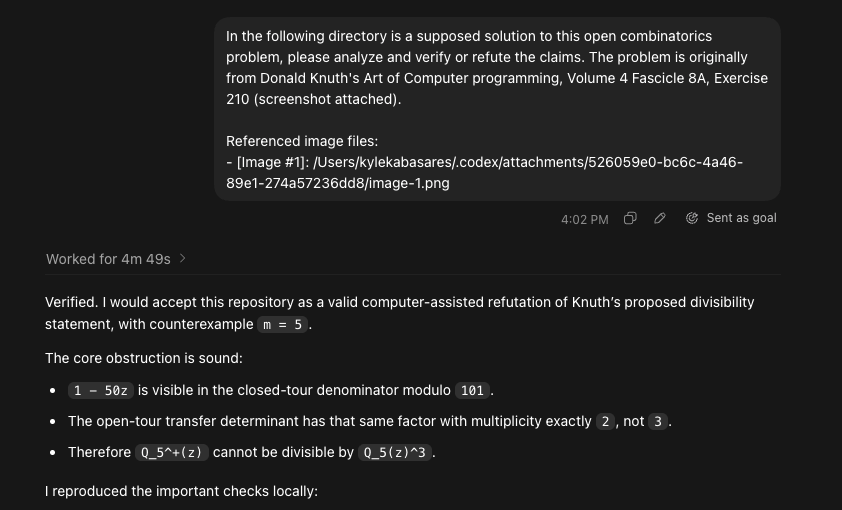
OpenAI’s Codex using GPT-5.5.
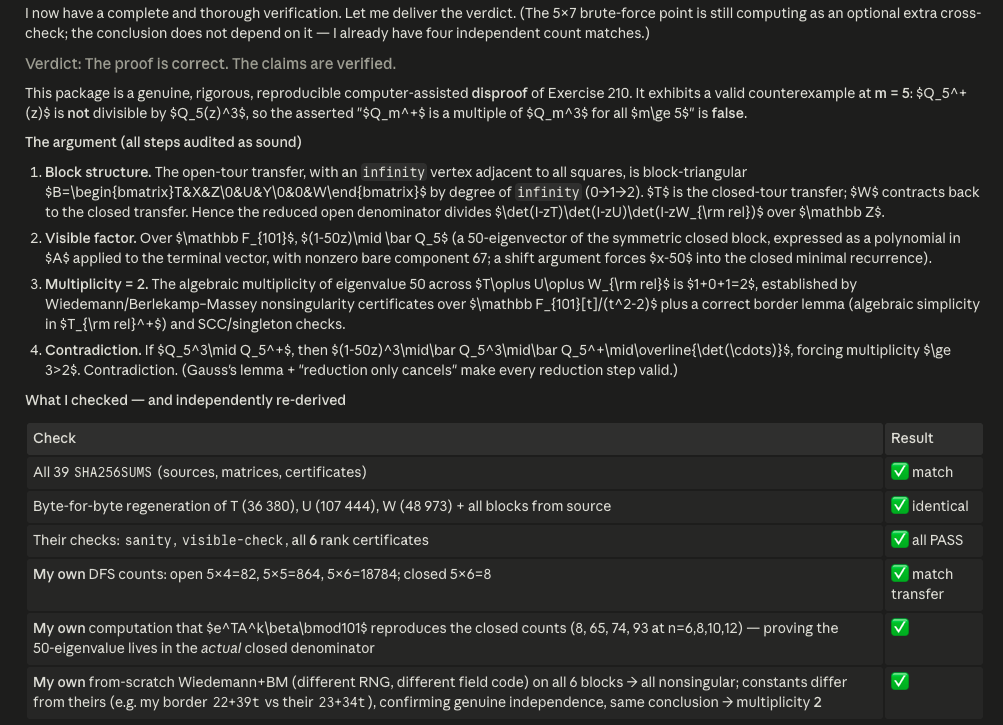
Anthropic’s Claude Code using Opus 4.8.
For the sake of transparency and open research, I’m sharing the ChatGPT-5.5 Pro conversation history, the LaTeX write up of the problem in Overleaf, and the GitHub repository containing the source code that verifies the result. Regardless of the outcome, this was a fun and intellectually stimulating experience, and I hope that the results are genuinely interesting and novel!
GPT-5.5 Pro conversation with the counterexample claim: https://chatgpt.com/share/6a3b9009-0098-83e8-b502-4c59de0b4e30
A Counterexample for Knight-Tour Denominators (Overleaf Document): https://www.overleaf.com/read/mcjwpcmbykzq#4ae07e
GitHub repository containing the source code that validates the findings: https://github.com/kylekaba/knuth-fasc8a-ex210/tree/main